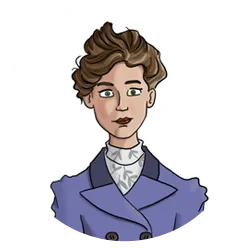
Ellen Abbott was born in Earls Barton, Northamptonshire, England, on the 1st July 1871, the daughter of George and Julianna Abbott (née Underwood). She was the
eldest of fourteen children in the family and her father was a shoemaker.
On completing her education she became a machinist in a shoe factory, and then in 1903, she married George Ward, who was a shoe ‘clicker’, and before immigrating to the United States of America in 1907, they had lived at ‘Sunnyside’, Earls Barton. They settled first in Newark, New Jersey, in the United States of America, and then Brooklyn, New York City.
In the spring of 1915, perhaps because of the Great War, the couple decided to return home to Earls Barton and consequently bought tickets as third class passengers on the Lusitania. Their liner was due to leave the port on the morning of 1st May 1915 but her sailing was delayed until the afternoon.
Six days later; however, on the afternoon of the 7th May, both the Wards survived her sinking, because they were able to get into one of the few lifeboats which was successfully launched.
After being rescued from the sea, and landed at Queenstown, they eventually arrived at Earls Barton and returned to ‘Sunnyside’, by this time the home of Mr. and Mrs. James Miles, Ellen Ward’s brother-in-law and sister-in-law, on Sunday 9th May. They had lost all their possessions, but were nevertheless feeling lucky to be alive!
Later in the week, both Mr. and Mrs. Ward were interviewed there by a reporter from The Northampton Mercury about their experiences. The interview was published in the edition of Friday 14th May, exactly one week after the sinking: -
"We had just had dinner," Mr. Ward said, and I was walking on the deck when the boat was struck. I saw something bright sticking out of the water some 500 yards from the ship, and this projection which strongly reflected the sun, was the periscope of the submarine. Immediately the boat was hit there was an explosion, and as soon as she was struck, she began to list. There came a second blow and a second explosion, but between the two I had climbed the railing to look for my wife, who was not with me at the moment. I found her and we ran into the second class cabin where there were a lot of lifebelts. I obtained one for her, and put it on upside down, a position in which it would have been of very little use, but after she had got into the lifeboat it was put right.
As soon as the boat began to list, the first and second class passengers rushed to the higher side and that is why so few of them were saved. After getting the lifebelt for my wife - I did not have one - we went to the lower side of the ship where boats were being launched. 'Ladies first!' was the cry, and I said to Mrs. Ward; 'You'll have to jump if you want to go.' She said, 'I can't,' but I replied, 'You'll have to.' Then she said 'You will come too,' and I answered, 'Never mind about me; there's a few more ladies.' She jumped and I handed in two or three more ladies. Then Mrs. Ward started screaming for me, and I jumped and reached the boat safely. I was about the last into the boat and the boat was the last to leave the ship.
The boat was built to hold 60; people said there were 85 in it but I do not think the number was quite so high. There were men women and children, among the last a small baby. We had to row over that part of the ship that was under water, for she sank rapidly and never shall I forget the awful
scenes. They were enough to send people crazy. There were hundreds of people in the water, some swimming some clinging to broken wreckage. Some locked in each others arms had met or were meeting the worst together. I noticed the third cabin interpreter swimming in a barrel, and I did not anticipate that I should see him again, but he was picked up.
The third cabin interpreter was crew member Adolph Pedersen who lived in Liverpool and who indeed was saved from the sinking and eventually got back home!
There had been no panic on board and there was no panic in the boat although everyone was deeply distressed and the screaming and the groaning of the poor people in the water was too terrible to describe. We did our best to rescue some of them, but the boat was full when it left the ship. I pulled one man in, and in all, our boat picked up three or four. We should never have got away but for the splendid work of two sailors who were in the boat. We had one of the best officers with us, and but for the skilful management of the seamen, we might have been drawn down by suction.
The sea was as calm as the River Nene; not a soul would have been saved had the weather been at all rough. There was not a ship in sight when we were struck and those who were fortunate to get into the boats, rowed for two or three hours before they were picked up. I myself had a long spell at rowing. At last we were taken on to a fishing boat from Peel and later on, transferred to a tug that had come out from Queenstown. This tug took us to Queenstown and landed us.
The fishing boat from Peel was probably the Wanderer, which just happened to be fishing in the area when the liner foundered and was able to rescue many survivors. It is probable also, that the lifeboat which helped save the Wards, was No. 15, commanded by First Officer A.R. Jones, who is described by Ward as one of the best officers. The tug was probably the Queenstown harbour tender Flying Fish. Mr. Ward continued with his account: -
Really, we are very lucky to be here," Mr. Ward remarked. "When the ship was settling down on her side, the end of a long apparatus used for despatching and receiving wireless messages came right across the top of our boat. Fortunately for us, it was very thin, and when it struck the boat it snapped otherwise we should probably have been pinned down and drowned."
At Queenstown, the survivors were well looked after. They were made as comfortable as possible in hotels and boarding houses, and those who had been immersed were provided with new clothing. The most that anyone escaped with was just the clothes he or she happened to be wearing. Mr. and Mrs. Ward were both fortunate enough to escape a wetting, but Mrs. Ward was hatless, and Mr. Ward was without a collar. "We got away with just what we stand in," Mr. Ward continued, "I've lost all my belongings among them a talking machine for which I gave £40, and records which cost another £10. All the household goods I was bringing over have gone, and none of my property was insured.
At Queenstown I spoke to a man I had helped into the boat. He was holding
a lifebelt and he said to me, 'This lifebelt and you saved my life, and it's all I've got now.' And his position is that of many of the survivors, for practically all their possessions went with the ship.
No warning was given before the ship was torpedoed," Mr. Ward said, "and hundreds of the passengers had no chance at all, for they were downstairs, and would be unable to escape. The boat went down in what seemed a very short time." Asked whether he received a warning before the boat sailed, Mr Ward replied that he saw the advertisement in 'The New York American', a copy of which he was bringing home. "I can tell you candidly," Mr. Ward said, "If I had seen that advertisement before I had booked our passages, I should not have been on the Lusitania. And yet who would have thought that a ship of that type would have been dealt with in such a way. We believed she was as safe as the Bank of England, and even when she was first struck, we thought she would float. I believe she would have done but for the second torpedo." .....
Mr. and Mrs. Ward left Queenstown on Saturday afternoon and when they arrived at Northampton early on Sunday morning, a friendly police constable directed them to a refreshment house in Bridge-street where they had breakfast. Afterwards, they despatched a message to Earls Barton asking that a conveyance be sent for them and naming a well known licensed house as a meeting place. The circumstances were explained to the license holder, but Mr. and Mrs. Ward were not allowed to enter the premises and they had to remain in the street until a lady, noticing their plight, invited them into her house. Mrs. Ward was able to accept, but Mr. Ward had to keep a sharp look-out for the conveyance which arrived in time to get them to Earls Barton soon after mid-day. The fine bodies of troops marching through the streets broke the monotony of his vigil.
Mrs. Ward, supplementing her husband’s story told how a lady, the wife of a clergyman, was drawn by suction into one of the funnels of the steamer and was blown out again looking blacker than a chimney sweep. “You really could not tell she was a white woman.” Mrs. Ward remarked. Some of the survivors were injured and one lady died on the smack which picked up the boat on which Mr. and Mrs. Ward left the wrecked vessel.
The wife of a clergyman ..... drawn by suction into one of the funnels of the steamer and blown out again was Mrs. Margaret Gwyer, who survived her ordeal and was also ultimately rescued by the Flying Fish, which is where Ellen Ward probably encountered her. She continued: -
Nurses on the tug gave the injured every attention, and everything that could be done, was done. At Queenstown Mrs. Ward met a fellow passenger with whose wife she had struck an acquaintance on the voyage. “His first words were,” said Mrs. Ward, “Have you seen my wife?” “I looked for her, but I was not able to find her,” was the sad reply Mrs. Ward had to make.
In the summer of 1915, the Wards successfully applied to The Lusitania Relief Fund for financial aid to help make up the loss of all their personal effects. The fund was originally set up by The Lord Mayor of Liverpool and other local dignitaries to help second and third class passengers who had suffered loss because of the sinking.
George and Ellen Ward never returned to the United States of America, and resided at 24. Oxford Street, Wellingborough, Northamptonshire, for many years, and it was while living her that George Ward died on the 21st September 1928, aged 60 years.
Sometime after her husband’s death, Ellen Ward moved to London End, Earls Barton, and she was residing her when she died in Northampton General Hospital on the 8th May 1949, aged 77 years.
Administration of her estate was granted in London on the 1st June 1949 to her brother, Herbert James Abbott, who was described as a retired clicker. She left an estate of £484-11s.-10d. (£484.59p.).
Register of Births, Marriages and Deaths, Northamptonshire England Church of England Baptisms 1813 – 1912, 1881 Census of England & Wales, 1891 Census of England & Wales, 1901 Census of England & Wales, 1910 U.S. Federal Census, 1939 Register, New York Passenger Lists 1820 – 1957, Cunard Records, Liverpool Record Office, Kettering Leader, Northampton Mercury, Probate Records, PRO BT 100/345, Graham Maddocks, Kate Wills, Michael Poirier, Jim Kalafus, Cliff Barry, Paul Latimer, Norman Gray.
Copyright © Peter Kelly.