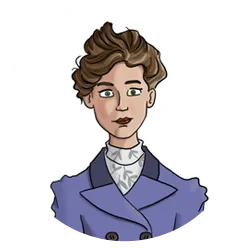
Olive North was born in Melbourne, in the West Riding of Yorkshire, England, on the 11th April 1889, the daughter of James and Marion North (née Barber). She had a twin brother named Roy Henderson, and they were the youngest of the eight children in the family. Both of her parents were school teachers.
Shortly after her birth, her mother secured a position as a school mistress in her native town of Heckmondwike, and brought her family with her. The family resided for a time at High Street, and later at Tidswell Street. Meanwhile, her father was the school master in Skelton, which is about 40 miles from Heckmondwike, and lived away from the family during the school year. As a young girl, Olive worshipped at The George Street Chapel in Heckmondwike.
In 1913, she had gone to stay with her sister in Saskatoon, Saskatchewan, Canada, and in the spring of 1915, she decided to return home because of the war. She then
booked second cabin passage on the May sailing of the Lusitania and having left Saskatoon at the end of April, she arrived in New York in time to catch the liner’s sailing, which began just after mid-day on 1st April 1915. On the voyage, she shared a cabin with Mrs. Winifred Hull who was travelling from Winnipeg, Manitoba, Canada, to visit her parents in Wallasey Cheshire. Winifred Hull later wrote of her experience to her husband George in Winnipeg, in which she mentions Olive North: -
..... Friday saw my friend & roommate Miss North up early on deck, but for a few hours fog prevailed. We went down to breakfast at 8.30 afterwards proceeding to our cabin and packing what things we could in preparation for landing, joking & laughing happily the while in happy anticipation of being on shore at that hour on the morrow. I think it was about 10 o'clock when we went back on deck and by that time the fog was lifted and the morning was warm and bright. We were on the boat deck the whole of the morning talking of the loved ones we were going to see after so long a time and I'm certain that neither of us ever gave a solitary thought to the possibility of our not arriving safely. We were in sight of land and home seemed too near not to be reached.
Well, the gong went for lunch and the passengers from the first sitting came crowding up on the deck again into the bright sunshine and then oh how quickly all was changed for that happy smiling crowd - (it seemed to me that almost everybody was more that usually jolly that morning) - we were half way through' lunch and I sat back in my chair, waiting for the next course, when suddenly there came the impact of the shot entering the ship directly underneath us; the sensation I felt then has never left me yet, we felt the shot rip its way thro' the ship, and the sound of in-rushing water, following it, was awesome. Just for the space of about half a second there was silence in the dining room, and then arose an awful cry of "she's struck, she's struck"; there was a rush for the stairway; but not a panic, the screaming coming mostly from the children, I think, of whom there were such great numbers on board. For my own part I rose from the table with the others made a few steps towards the door of the saloon and then stopped, thinking it hopeless. Then I caught sight of Olive North and ran to her calling her name, I caught her by the hand but she pulled away from me without knowing it, and in a second I had lost sight of her. Then I turned & stood in the corridor at the side of the stairway whilst the rush of people towards the decks continued.
Olive North also wrote an account of her experience of the sinking which was later published in a book, One Valley's War, by local author Andrew Bannister: -
Right up to the time of the disaster the voyage had been a most enjoyable one, the sea having been pretty smooth all the way and the weather beautifully fine. Just before we were struck by the torpedo, I was having luncheon in the second class dining saloon. We were all laughing and joking about the submarine scare which none of the passengers seemed to regard as of any moment.
One young gentleman said to me, “am going to lie down. Will you wake me up if we are struck?” Another passenger, a lady, remarked, “I am tired of listening to these tales about submarines and torpedoes. There is nothing in them”.
Soon after the latter remark had been made there was a loud bang and everyone appeared to know at once that we had been struck. I remember someone shouting, “Be calm, don't rush”, and although we were all unnerved, I heard no screaming. I had always been told not to run in a panic, and I stood there until the dining room was almost emptied of passengers. The ship was reeling, and the crockery and utensils were flying in all directions.
To reach the boat deck I had to mount six flights of steps, and the sight that met me at the top was appalling. The vessel was tilted at such an angle that one could hardly walk in safety. One end of the ship was high up in the air, and the other dipping into the water, and many people on the starboard side must have been thrown into the sea and drowned. Standing on the deck I saw a lifeboat containing about seventy people being lowered. Directly it touched the water the boat capsized, and all its occupants were pitched into the sea.
After what seemed about ten minutes the ship began to sink and I went down with it. We seemed to go down and down until we touched something, and then I lost consciousness. When I came to again my head was out of the water and I managed to grasp hold of the lifeboat that had capsized. A little later, a young man pulled me on to the upturned boat.
According to Adolph and Mary Hoehling in their 1956 book, The Last Voyage of the Lusitania, the upturned boat was a collapsible boat which had been made seaworthy by second cabin passengers Archibald Donald and George Bilbrough.
Eventually, the occupants of the lifeboat were rescued by the Royal Naval Trawler H.M.S. Brock and Olive North put on a man’s suit that she found in one of the ship’s cabins before being landed at Queenstown where the Hoehlings describe what she saw next: -
Olive North, from the minesweeper Brock, watched a male survivor leap on to the wooden barrier at the gangway of the pier. Shouting hysterically, he seemed to think he was back on the Lusitania. Two policemen finally pulled him down.
Eventually, she managed to get back home to Heckmondwike but not before she had been able to send a telegram home from Queenstown, which simple stated: -
SAFE, OLIVE.
Another one arrived on the morning of 10th May 1915, sent from Dublin which reaffirmed her survival.
One fellow second cabin passenger who was killed and whose body was never recovered from the sea and identified afterwards was Richard Preston Pritchard, who originally came from Ramsgate in Kent. In an attempt to learn more of his fate, his brother Mostyn first went to Queenstown to search in vain for him or his body. Then, his mother wrote to many surviving passengers and crew members seeking any information about him.
One of these was Olive North and on the 11th September 1915, she first replied to the letter she had received from Mrs. Pritchard stating: -
19. Cambridge St.
Heckmondwike
11th Sept 1915.
Dear Mrs. Prichard,
I am very pleased to be able to tell you a little about your son.
I remembered his face as soon as soon as I saw his photograph. I saw him many times on deck, but only spoke to him once & that was only for a few minutes. A party of us used to have a game of skipping every day and one of the boys tried to lasso me, the day before we were torpedoed, but did not manage to do it very well, so this young gentleman – your son, had been watching us, came forward & said, I will show you how to do it. He seemed to be an expert at Lassoing & caught quite a few in the rope, when he handed me the rope back, he remarked that he had lassoed before. I never saw him again after this.
I was having lunch when the torpedo hit us. D deck was I think on the same floor. We had time to get out onto the boat deck – even though the boat was tilted at such an angle – by pulling ourselves up the bannisters, having to go up 6 flights of stairs. If your son were in his cabin he would have time to get on deck. I was taken out of the water & put on to an up turned boat & afterwards taken onto a collapsible boat. I was not in Mr. Parrys nor Mr. Mortons boat & did not see anyone with a lifebelt on like you mention.
Sorry I can’t tell you anything more about your son. My heart goes out to you – in your great loss. Oh it is just terrible to think about!!!
I will enclose address of some of our rescued party – Hoping you will hear more of your loved one.
Yours very sincerely
Olive North.
Before the war, she had had an ‘understanding’ to marry a local man named Percy Hanson, who joined the Royal Navy in September 1914, as a radio operator. Radios had always been an interest of his and he had set up the first wireless receiving station in the Heckmondwike area in 1912. From October 1914 until March 1915, Petty Officer Hanson served on board the cruiser H.M.S. Juno, out of Queenstown, which later played its own part in the Lusitania story. The cruiser had originally put to sea to help with the rescue operations, but had been recalled for fear that she, too, might fall prey to the U-20. By this time, however, Hanson was serving on Atlantic Ocean blockade duties in the armed merchant cruiser H.M.S. Marmora.
Following Olive North’s rescue and return to Heckmondwike, in the summer of 1915, she and Percy Hanson became engaged and in August 1918, they married in The George Street Chapel! The couple later ran the post office together in Heckmondwike, and had four children – Leslie, Sidney, Margaret, and Eileen.
Also in the summer of 1915, she applied for financial assistance to The Lusitania Relief Fund, which had been set up after the disaster by The Lord Mayor of Liverpool and other worthy dignitaries, to help those survivors and relatives of the dead, who found themselves in difficulties as a result of the sinking. The committee administering the fund declined to make any payment to her, Stating: -
“No apparent need – Case closed”.
Olive North also had three brothers who served in the British Army in the Great War, all of them surviving.
Percy and Olive Hanson moved to Blackpool, Lancashire, when they retired, and resided at 79. Anchorsholme Lane, Cleveleys, Blackpool. Olive Hanson died on the 4th July 1976, aged 87 years. Her husband died in Blackpool in 1981.
Register of Births, Marriages and Deaths, 1891 Census of England & Wales, 1901 Census of England & Wales, 1911 Census of England & Wales, 1939 Register, Cunard Records, Liverpool Record Office, IWM GB62, Bradford Daily Argos, One Valley's War, Heckmondwike at War, Last Voyage of the Lusitania, PRO BT 100/345, UniLiv D92/2/55, Graham Maddocks, David Irving, Roger Lancaster, Geoff Whitfield, Michael Poirier, Jim Kalafus, Cliff Barry, Paul Latimer, Norman Gray.
Copyright © Peter Kelly.