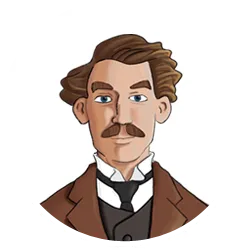
Osmund Bartle Wordsworth, known as “Barty”, was born in Glaston, Rutland, England, on the 17th May 1887, the son of Christopher and Mary Wordsworth (née Reeve). His father was a clergyman and the rector of Glaston at the time of Osmund’s birth. Osmund was the second youngest of nine children, and he was a great-grand-nephew of the poet, William Wordsworth.
He was educated at Mr. Pellat’s School, Langton Matravers, Dorset, and then at Winchester College, where he was an Exhibitioner and a School Praetor in 1904, and Bib Praetor in 1906. He also became Prefect of the Library, won the Warden’s and the Fellow’s Prize for Greek Prose and Greek Iambics, and yet he still found the time to play for the Rugby XV in 1906!
In 1906, he won a Major Scholarship to Trinity College Cambridge, where he achieved a BA 1st Class Tripos in 1909, 1st Class Tripos Part II in 1910, followed by an MA in 1913.
He was a master at Lancing College in 1911, and was also a lecturer at Selwyn College from 1911 to 1914. In 1914, he published a novel, entitled ‘The Happy Exchange’, under the pen name of Herbert B. Thorneley.
On the 24th September 1914, he arrived in Quebec City, Quebec, Canada, on board the Andania, having sailed from London. He continued overland to Toronto, Ontario, where he took up a position as a lecturer at Trinity College, Toronto, and also enlisted as a private at the Officer Training School in October 1914.
In the spring of 1915, he decided to return to England and enlist in the British Army. Consequently, he booked second cabin passage on the May sailing of the Lusitania, which was scheduled to leave the Cunard berth at Pier 54 in New York on the morning of 1st May 2001.
Having left Toronto at the end of April, he arrived in New York in time for the liner’s scheduled departure. On arrival in New York City, he met his sister, Miss Ruth Wordsworth, who was a missionary in Japan, and who had travelled to New York to join him on the voyage home. The liner’s sailing was then delayed until the afternoon as she had to embark passengers, crew and cargo from the Anchor Liner Cameronia, which had been requisitioned by the British Admiralty for war service as a troop ship, at the end of April.
The Lusitania finally left port just after mid-day and just six days later, on the afternoon of 7th May; she was torpedoed and sunk by the German submarine U-20. At that point, she was off The Old Head of Kinsale in southern Ireland and only hours away from her Liverpool destination.
Both Osmund and Ruth Wordsworth survived this action, however, probably because they were able to get into one of the few lifeboats which were successfully launched and having been landed safely at Queenstown, they eventually completed their journey to their home in Salisbury, where by this time; their father was the Chancellor of Salisbury Cathedral.
Having recovered from his ordeal, Osmund Wordsworth travelled to Selwyn College Cambridge, where on the 17th May; he applied for a commission in the British Army. He was commissioned as a 2nd Lieutenant in the 9th Battalion of the Oxfordshire and Buckinghamshire Light Infantry on the 11th June and reported for training at the Portsmouth Garrison on the 15th June.
On the 17th April 1916, he transferred to the 21st Company of the Machine Gun Corps, and then, on the 31st August, he embarked with his company for France, disembarking in Boulogne. He attended machine gun school in Camiers on the 15th November 1916, returning to his unit on the 26th.
In January 1917, he travelled to England on leave, and on returning to France, joined his unit on the front line.
On the 2nd April 1917, he was tasked with positioning his guns to support an attack at Henin-sur-Cojeul Pas-de-Calais, France, about 10km southeast of Arras. Surviving reports state that he saw one of his gun crews having difficulty getting into position, and refusing to allow any of the men he had placed in shelter to carry out his instructions, he went himself to give assistance. He was seen to be fatally shot through the heart, and was later buried in a lone grave, the location of which was lost in subsequent fighting. He is commemorated on Bay 10 of the Arras memorial
Probate of his Will was granted in London on the 3rd May 1917 to his brother, John Vincent Wordsworth, and his sister, Susannah Mary Wordsworth. He left an estate of £1,262-1s.-4d. (£1,262.06½p.).
In 2013, following a period of heavy rain, a farmer in Henin-sur-Cojeul discovered human remains in his private garden, which were subsequently identified as being a
British soldier from World War I. The remains, unidentified, were buried in the Commonwealth War Graves Cemetery at Écoust-Saint-Mein in September 2015. Then, in October 2021, with the help of DNA analysis, these remains were positively identified as being those of 2nd Lieutenant Osmund Bartle Wordsworth. In the summer of 2022, a re-dedication ceremony was held where a gravestone bearing his name was positioned over his grave.
Births, Marriages and Deaths, Rutland Baptisms, 1891 Census of England & Wales, 1901 Census of England & Wales, Canadian Passenger Lists 1865 – 1935, U.S. Border Crossings from Canada to U.S. 1895 – 1960, Cunard Records, Commonwealth War Graves Commission, British Army World War I Medal Roll Index Cards 1914 – 1920, UK Army Registers of Soldiers’ Effects 1901 – 1929, Soldiers of Oxfordshire Museum, Lancing College War Memorial, Bugle and Sabre, Probate Records, Graham Maddocks, Tom Shannon, Ingram Murray, Geoff Whitfield, Michael Poirier, Jim Kalafus, Cliff Barry, Paul Latimer, Norman Gray.
Copyright © Peter Kelly.