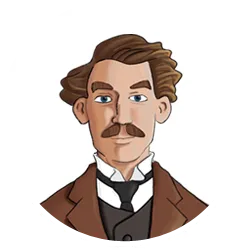
Owen Hill Kenan was born in Kenansville, Duplin County, North Carolina, in the United States of America, on 23rd May 1873, the son of James Graham and Annie Elizabeth Howard Kenan (née Hill). His family were very well known, and respected, throughout North Carolina.
In 1736, Thomas Kenan had emigrated from Ireland to Wilmington, North Carolina, and established his home at Turkey Branch Plantation, near the town of Turkey, North Carolina. The plantation was inherited by his son, James Kenan, who was a Brigadier General of the Wilmington District Brigade during the American Revolutionary War, and became the commander of the North Carolina Militia after the war. He re-named the family home ‘Liberty Hall’, however, this house was destroyed by a fire prior to 1800, and James Kenan built the new Liberty Hall in Kenansville, which was a town named in his honour. James Kenan was a respected politician who served ten terms as a state senator.
When James Kenan died in 1860, the estate was inherited by his eldest son, Owen Rand Kenan, who along with his three sons, served in the Confederate Army during the American Civil War. Owen Rand Kenan served as a Major during the war, and also served in the North Carolina House of Commons from 1834 to 1838, and the First Confederate Congress from 1862 to 1864. On his death in 1887, his unmarried daughter, Annie, inherited Liberty Hall.
Owen Hill Kenan was educated at Horner’s Military Academy, Oxford, North Carolina, and later graduated from the College of Physician’s and Surgeons. He became a medical practitioner and his home and practice were in Wilmington, North Carolina. He served as a physician with the U.S. Army during the Spanish-American War in 1898. In 1910, he purchased an apartment in Paris, France, and also had a house in Florida. He was an avid art collector.
In the spring of 1915, he decided to travel to France to escort his niece, Louise, back to North Carolina, and as a consequence, he booked saloon passage for himself on the Lusitania’s May sailing from New York to Liverpool.
Having left Wilmington at the end of April, he stayed at the Plaza Hotel in New York City, before joining the liner (with ticket number 46143), at her berth at Pier 54 in New York harbour on the morning of 1st May 1915. Once on board, he was escorted to his cabin, B100, which was the personal responsibility of Saloon Class Bedroom Steward Percy Penny, who came from Aigburth on the outskirts of Liverpool.
The liner’s sailing was delayed, because she had to embark passengers, cargo and some crew from the Anchor Liner Cameronia, which had been requisitioned for war work by the British Admiralty at the end of April. The Lusitania finally left her moorings and slipped into the North River just after mid-day.
Six days later, she was torpedoed and sunk, twelve miles off the coast of southern Ireland by the German submarine U-20, only hours away from her destination. Dr. Kenan managed to survive the sinking and after being rescued from the sea and landed at Queenstown, he had to be taken to hospital to recover from his ordeal before being pronounced fit to travel again! He was aged 42 years at the time of his ordeal.
In his book The Tragedy of the Lusitania, written just after the sinking, Captain Frederick D. Ellis mentioned that Dr. Kenan had praised the last minutes of millionaire saloon passenger Alfred Vanderbilt, as he said: -
He saw him at the rescue work. Then when nothing more could be done, Vanderbilt buckled a lifebelt over the heavy overcoat he wore. He was leaning against a gateway when Dr. Kenan last saw him. ‘They’ve got us now,’ said the millionaire as Dr. Kenan passed.
Vanderbilt must have taken off the lifejacket to give to someone else after Dr Kenan had last seen him, for many other accounts state that he gave his lifebelt away and faced the liner’s sinking without one, even though he could not swim!
An article published in The British Medical Journal on 15th May 1915 states Dr. Kenan perished in the sinking, but this was clearly mistaken.
Bedroom Steward Penny, who had looked after Dr. Kenan in room B100 also survived the sinking and eventually got back to his Aigburth home.
Following his recovery, he went to France where he worked with the Ambulance Corps, and was awarded the Croix de Guerre by the French Government for his outstanding service.
In 1906, his great-aunt, Annie Kenan died, and possession of the estate passed to her
niece, Mary Lilly, who was a first cousin of Owen’s. She was married to Henry Flagler, who was one of the richest men in the world, having founded the Standard Oil Company with John D. Rockefeller, and being responsible for building most of the railroads in the state of Florida. As Mary Lilly’s home was in Florida, Liberty Hall, and its contents, had been boarded up since 1906, and following her death in 1917, Owen inherited Liberty Hall, and millions of dollars!
When American entered the war in 1917, Owen volunteered for service with the American Expeditionary Forces Medical Corps, and rose to the rank of Colonel. He served on the Western Front, and later with the relief mission to Russia until 1919.
After the war, Dr. Kenan travelled back and forth to Europe on an annual basis, spending more and more of his time, and money, on his art collection.
Dr. Owen Kenan died on the 9th July 1963 at Wilmington, North Carolina, aged 91 years. He was laid to rest in Section 35, Site 2858 , in Arlington National Cemetery.
Dr. Kenan had never married, and left Liberty Hall and its contents to his nephew, Frank H. Kenan, who donated it to the Board of Education, and through a number of Kenan family trusts, it is now a public museum.
North Carolina Death Certificates 1909 – 1976, 1880 U.S. Federal Census, 1930 U.S. Federal Census, New York Passenger Lists 1820 – 1957, U.S. Army Transport Service Passenger Lists 1910 – 1939, Cunard Records, British Medical Journal, Tragedy of the Lusitania, PRO 22/71, UniLiv D92/2/157, Graham Maddocks, Geoff Whitfield, Michael Poirier, Jim Kalafus, Cliff Barry, Paul Latimer, Norman Gray.
Copyright © Peter Kelly.