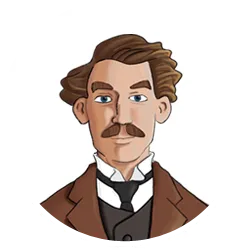
Patrick Llewellyn Jones was born in Clerkenwell, London, Middlesex, England, on the 8th August 1886, the son of William Benjamin and Eleanor Jones (née O’Brien). His father was a printer and compositor. He was one of ten children; however, six of his siblings had died by 1911.
On the 4th April 1914, he married Georgette Sarah Schwarz in London, and the couple lived at 14a, Whitehead Grove, Chelsea, Middlesex, England. He was a London staff photographer and journalist with The International News Service.
On the 10th April 1915, he boarded the St. Paul at Liverpool as he was going to New York City in connection with his work. It was his first visit to the United States of America. For his return to London, he purchased a second cabin ticket on the Lusitania from New York to Liverpool, which was scheduled to depart on the 1st May. Having concluded his work, he arrived at the Cunard berth at Pier 54 in New York in time for the liner’s scheduled 10 o’clock sailing. He then had to wait until 12.27 p.m. before the liner actually left there, because she had to embark passengers, crew and cargo from the Anchor Lines ship
Cameronia which the British Admiralty had requisitioned for war service as a troop ship.
Six days later, on the afternoon of 7th May, the Lusitania was sunk by the German submarine
U-20, within sight of the coast of southern Ireland. Patrick Jones survived the initial torpedoing of the vessel, but died, professional to the end, trying to photograph the dramatic events of the sinking. This is described by saloon passenger Charles T. Jeffery in the book The Last Voyage of the Lusitania by Adolph and Mary Hoehling: -
Charlie T. Jeffrey a Kenosha, Wisconsin automobile manufacturer, spied Jones on the starboard side of B Deck. His arm wrapped around a stanchion, he balanced himself further with a foot against the rail. He was taking pictures as fast as he could load and focus his camera.
“You'd better get off this boat!” Jeffrey shouted.
"These'll be the greatest pictures ever!” replied Jones, not pausing to look at the other man.
Jeffrey thought it “the coolest thing” he would ever see, then hastened along the deck.
“The coolest thing” or not, Patrick Jones did not survive, nor did his camera or photographs, which undoubtedly would have been
the greatest pictures ever! His body was eventually recovered from the sea, and landed at Queenstown, where it was given the reference number 94 in one of the temporary mortuaries set up there.
Once a positive identification had been made, it was handed over to Mr. H.R. Talbot, the manager of The International News Service, and the journal
New York American, of 67, Fleet Street, London. Under his instruction, on 11th May 1915, it was despatched to London for burial. Patrick Llewellyn Jones was aged 28 years when he was killed.
On the 17th May 1915, Patrick Llewellyn Jones was laid to rest in one of the cemeteries in Haringey, London. His coffin was draped with both the Union Jack, and the Stars and Stripes of the United States of America
Administration of his estate was granted to an Ernest George Schwarz, who was an artist and his father-in-law, at London on 16th October 1915. His effects amounted to £167-8s-0d, (£167.35p).
Register of Births, Marriages and Deaths, 1891 Census of England & Wales, 1911 Census of England & Wales, New York Passenger Lists 1820 – 1957, Cunard Records, Daily Mirror, Last Voyage of the Lusitania, Probate Records, PRO BT 100/345, Graham Maddocks, Geoff Whitfield, Michael Poirier, Jim Kalafus, Cliff Barry, Paul Latimer, Norman Gray.
Copyright © Peter Kelly.