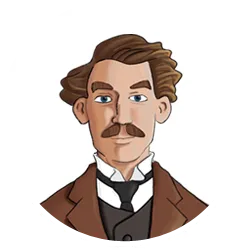
Harold Percy William Rogers, known as “Percy W.” was born in Highgate, London, England, on the 22nd July 1869, the son of William Charles and Laura Cox Rogers (née Webb). His father was a stockbroker’s clerk, and Percy was the eldest of seven known children.
In August 1871, the family immigrated to Barrie, Simcoe North, Ontario, Canada, where his father found work as an accountant, and on completing his education, Percy became a clerk.
On the 5th September 1896, he married Ida Melvina Battis in Toronto, and the couple had four children – Lillian Victoria, born in 1897, Percy Arthur William, born in 1899, Harold Robert Leonard, born in 1903, and Annie Laura May, born in 1906. The family lived for many years at 441. Euclid Avenue, Toronto.
By 1915, Percy was the assistant manager and secretary of the Canadian National Exhibition, an annual event that is held in Toronto to this day. In this capacity, he found it necessary to travel to England, perhaps to attract exhibitors, and consequently, booked as a saloon class passenger on the Lusitania, scheduled to sail to Liverpool from New York on the 1st May.
He left Toronto at the end of April and arrived at the Cunard berth at Pier 54 in New York harbour on the morning of Saturday, 1st May, in time for the liner’s scheduled 10 o’clock departure. The departure time was delayed until after midday whilst the Lusitania took on board passengers, cargo, and some of the crew from fellow
Cunarder Cameronia, which the British Admiralty had requisitioned as a troop ship at the end of April.
Mr. Rogers had booked his passage through Robert Reford and Company of Toronto, and with ticket number 6928, he was allocated room D44, which was under the personal supervision of First Class Bedroom Steward William Barnes, who came from New Brighton, Cheshire, on the opposite side of the River Mersey from Liverpool.
Six after the liner had left New York, in the early afternoon of 7th May; the Lusitania was torpedoed and sunk off the coast of southern Ireland by the German submarine U-20. At that stage of her voyage, she was only hours away from her home port of Liverpool.
Percy Rogers was fortunate enough to be counted amongst the survivors, and having been rescued from the sea and landed at Queenstown, he continued on his way to London, England, where he gave an interview to a correspondent from the Canadian Associated Press. This interview was syndicated throughout North America and Canada, one of the newspapers that printed it was The Ottawa Citizen, in their edition of the 10th May: -
…”Everything went well till Friday morning. Submarines were, of course, occasionally the subject of conversation, but were not regarded seriously, the opinion being freely expressed that a boat with the speed of the Lusitania was more than equal to any submarine. Nobody, therefore, was disturbed with the thought of being torpedoed.
“Early Friday morning,” continued Mr. Rogers, “we sighted the Irish coast. Then we entered a slight fog and speed was reduced, but we soon came into clear atmosphere and the pace of the boat was increased. The morning passed. We went as usual down to lunch, although some were a little later than others in taking the meal. I should think it would be about ten minutes past two when I came from lunch. I immediately proceeded to my state room close to the dining room, to get a letter which I had written. Whilst in there I heard a tremendous thud. I came out immediately. There was no panic where I was, but people were aghast. It was realized the boat had been struck apparently on the side nearest land. The passengers hastened to the boat deck above.
Percy Rogers was mistaken when he stated that ‘the boat had been struck apparently on the side nearest land’ as the torpedo struck on the starboard, or right-hand side, while the port side, or left-hand side, was the nearest side to land. He continued: -
“Life boats were hanging out, having been put into that position the previous day. The Lusitania soon began to list badly, with the result that the side on which I and several others were standing went up as the other side dropped.
IN LAUNCHING BOATS.
“This seemed to cause a difficulty in launching the boats, which seemed to get bound against the side of the liner. It was impossible, of course, for
me to see what was happening at the other places, but among the group where I was stationed there was no panic. The order was given “women and children first,” and was followed implicitly. The first boat lowered with people at the spot where I stood smacked upon the water, and as it did so the stern of the life boat seemed to part and the people were thrown into the sea. Other boats were lowered more successfully.
“We heard somebody say ‘get out of the boats, there is no danger.’ Some people actually did get out, but the direction was not generally acted upon.
“I entered a boat in which there were men, women and children, I should say between twenty and twenty-five. There were no other women and children standing on the liner where we were, our position, I should think, being about the last boat but one from the stern of the ship.
“Our boat dropped into the water and for a few minutes we were all right, then the liner went over. We were not far from her.
“Whatever the cause may have been, perhaps the effect of suction, I don’t know, but we were thrown into the sea. Some of the occupants were wearing life belts. I was not. The only life belts I knew about were in the cabins and it had not appeared to me there was time to risk going there.
“It must have been about 2.30 when I was thrown into the water. Here is the watch which I was wearing. You will see it stopped at that time.” As he said this, Mr. Rogers produced a watch from his pocket, which indicated it had stopped at half past two.
“What a terrible scene there was around me. It is harrowing to think about the men, women and children struggling in the water. I had the presence of mind to swim away from the boat and made towards a collapsible boat upon which was the captain and a number of others. For this purpose I had to swim quite a distance.”
Percy Rogers was aged 45 years at the time of the sinking, and having conducted his business in London, he boarded the St. Paul at Liverpool on the 5th June, and after an uneventful voyage to New York, made his way to his home in Toronto.
Bedroom Steward Barnes who had looked after Percy Rogers in room D44 also survived the sinking and eventually returned safely to his New Brighton home.
Percy Rogers filed a claim with the Canadian Commission, stating that a result of his ordeal he had to give up his position with the Canadian National Exhibition. He claimed for the loss of his personal effects, loss of his health, and the loss of his earning power. He also claimed for an operation, doctor’s fees, and hospital expenses for an appendectomy, he claimed was as a result of being dragged into a lifeboat. He was eventually awarded $7,188.75 in compensation.
Although there were also four other people named Rogers, from Toronto, travelling on board the sailing, Mr. and Mrs. F.A. Rogers, Miss E. Rogers and Mr R.J. Rogers, Percy Rogers was not related to any of them.
Percy Rogers worked in the insurance and brokerage business after resigning from his position with the Canadian National Exhibition and continued to reside in Toronto, the family home for many years being at 144. Geoffrey Street, and it was here, on the 21st September 1938, his wife, Ida, died from cancer of the liver, aged 62 years.
Percy Rogers died in Toronto on the 5th October 1967, aged 98 years. He was buried in Section 12, Lot 1211, in Mount Prospect Cemetery, Toronto, beside his wife. Interred with them is their youngest daughter, Annie Laura May, who died in 1917, aged 11 years.
Register of Births, Marriages and Deaths, 1871 Census of England & Wales, 1881 Census of Canada, 1891 Census of Canada, 1901 Census of Canada, 1921 Census of Canada, Canadian Passenger Lists 1865 – 1935, New York Passenger Lists 1820 – 1957, Cunard Records, Canadian Claims Case No. 785, Manchester Courier, Ottawa Citizen, Last Voyage of the Lusitania, Graham Maddocks, Lawrence Evans, Geoff Whitfield, Michael Poirier, Jim Kalafus, Cliff Barry, Paul Latimer, Norman Gray.
Copyright © Peter Kelly.