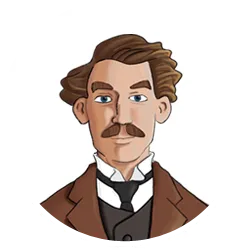
Richard Rich Freeman Junior was born in Quincy, Massachusetts, in the United States of America, on 28th October 1886, the son of Richard Rich and Mary Turner Freeman (née Manson). He had two younger sisters, Elizabeth, born in 1888, and Catherine, born in 1892. The family home was at Woolaston, Boston, Massachusetts and his father was a ship broker, by occupation, and a well-known and prominent Massachusetts golfer.
Richard Freeman junior was educated at Harvard University and graduated as a mining engineer. In the spring of 1915, he booked saloon passage on the May sailing of the
Lusitania from New York to Liverpool, and then on to London. His ultimate destination was Imperial Russia and the mines of Siberia, where he had secured a position. Prior to this, he had been employed as a mining engineer in Michigan.
Consequently, having left Boston at the end of April he arrived at the liner’s berth at Pier 54 in New York harbour on the morning of 1st May 1915, in time for her 10.00 a.m. departure. Boarding her with ticket number 1390, and personal belongings to the value of $560.20, he was escorted to his room, D4, which he shared with Mr. Harold Daley from Ottawa. Room D4 was in the charge of First Class Bedroom Steward William Fletcher, who came from Wallasey in Cheshire, on the opposite bank of the River Mersey from Liverpool.
The liner’s morning departure was delayed until the early afternoon, however, as she had to take on board cargo, crew and passengers from the Anchor Liner
Cameronia which had been requisitioned by the British Admiralty for war service in New York, at the end of April. Richard Freeman would have had his last view of his homeland just after mid-day as the
Lusitania edged her way from her berth and out into the North River and the Atlantic Ocean.
Six days later, on the afternoon of 7th May, he was killed after the steamer was torpedoed and sunk by the German submarine
U-20, twelve miles off the coast of southern Ireland and only 250 miles away from her Liverpool destination.
It seems that he survived the initial impact of the torpedo and must have been drowned after that, for on 11th May 1915, the Cunard office in Queenstown received the following cable from relatives in Boston: -
ASK DR. HOUGHTON SURVIVOR WHEN HE LAST SAW RICHARD FREEMAN AND IF FREEMAN LEFT STEAMER UNINJURED.
DR. HOUGHTON was fellow saloon passenger James T. Houghton, from Saratoga Springs, New York, who must still have been in Queenstown on 11th May, for the reply to the cable, which was sent on 13th May stated: -
DR. HOUGHTON STATES THAT HE AND FREEMAN JUMPED INTO THE SEA TOGETHER WERE SEPARATED. FREEMAN WAS UNINJURED THEN BUT REGRET THERE IS NO TRACE OF HIM.
No trace of him was ever found, in fact, and as a result, he has no known grave. He was aged 28 years at the time of his death.
Bedroom Steward Fletcher, who had looked after Richard Freeman and Harold Daly in room D4 did survive the sinking, however and eventually made it back to his Wallasey home. Harold Daly also survived.
Richard’s parents filed a claim for compensation for the loss of his life and his personal belongings, which was considered by the Mixed Claims Commission. The Commission subsequently awarded them the sum of $10,000 for the loss of their son, and a further $560.20 for the loss of his personal belongings.
Massachusetts Birth Records 1840 – 1915, Massachusetts Town and Vital Records 1620 – 1988, 1900 U.S. Federal Census, 1910 U.S. Federal Census, U.S. Passport Applications 1795 – 1925, Cunard Records, Mixed Claims Commission Docket No. 464, New York Times, PRO 22/71, PRO BT/100/345, UniLiv. PR13/6, Deaths at Sea 1871 – 1968, Graham Maddocks, Geoff Whitfield, Michael Poirier, Jim Kalafus, Cliff Barry, Paul Latimer, Norman Gray.
Copyright © Peter Kelly.