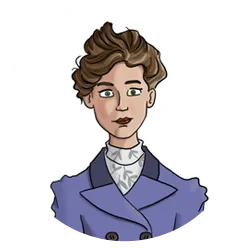
Rose Howley was born in Kincuillew, Kilmacteige, County Sligo, Ireland, on the 26th June 1865, the daughter of Thomas and Mary Howley (née O’Hara). Her father was a farmer, and Rose was one of many children.
As a teenager, Rose and quite a number of her siblings went to England in search of work. They settled in Keighley, Yorkshire, where they found work in the local woollen mills. Her brother, Michael, becoming a town councillor, and the leader of the Irish Party in Keighley. The family resided at 22. Peel Place, Keighley.
On the 13th February 1897, she married Michael Howley, who was her cousin, and who was also from Ireland. The couple had no children, and separated after two years of marriage, although they didn’t divorce, and Rose styled herself as a married woman for the remainder of her life.
It is not known when she travelled to visit one of her sisters in New Rochelle, New York, U.S.A., but for her return to Keighley in the spring of 1915, she booked as a third class passenger on the May sailing of the Lusitania, and was fortunate enough to survive when the liner was sunk.
Having been rescued from the sea and landed at Queenstown, she arrived at her home in Keighley on the afternoon of 9th May, exhausted and suffering from the effects of exposure, but otherwise all right. She later gave an account of her survival to a representative of The Bradford Daily Telegraph, which was published on 10th May. The account said: -
Mrs. Howley and another woman were walking along the deck when the first torpedo struck the ship. They were knocked down by the rush of passengers which followed, and later a man put a small lifebelt around Mrs. Howley's neck. Just then she caught sight of a rope hanging down the side of the vessel, and as people, were then jumping overboard, she seized the rope and slid down it into the sea. By this time the ship was sinking rapidly, and almost as soon as she entered the water, there was a big explosion as if the ship's boilers had blown up.
People were blown into the air, and the sight was a terrible one. When the ship went down, Mrs. Howley was drawn under by the suction, but through her lifebelt, she came to the surface, and all around, people were struggling and crying for help. For a second time, Mrs. Howley was drawn down, and on rising again, she touched a hard substance which proved to be an upturned boat, to the keel of which two or three men were already clinging. She appealed to them for help, and they encouraged her to retain her hold. She did so, and eventually one of the men managed to pull her partly up the boat.
While she had been endeavouring to get a firm hold on the boat, Mrs. Howley had felt something tugging at her dress and looking round, she noticed a little girl. She exclaimed "Oh, it's a child," and with the assistance of the men, the girl was pulled up as well.
Mrs. Howley then recognised her as Edith Williams, one of a family with whom she had become acquainted on the ship. There were the mother, five girls, and a boy, and only the boy and Edith were saved.
The group clung to the boat for four hours before assistance reached them. Two other of the ship's boats came near and linked themselves with the upturned boat. They did what was possible to rescue those struggling around, and two women were taken up in a very exhausted condition.
At length a steamer was seen approaching, and a man in one of the boats hoisted a portion of his clothing on the end of an oar and signalled for help, while the people in the boats shouted as hard as they could.
Twenty minutes later, the shipwrecked people were taken on board, and later were landed at Queenstown.
In the summer of 1915, she successfully applied to The Lusitania Relief Fund, which was administered by The Lord Mayor of Liverpool, for compensation for the ordeal she had undergone. Because of her loss of health and her consequent inability to obtain work, she was awarded a grant of £0-10-0s., (£0.50p.), per week, which commenced on 9th June 1915. It is not known how long she received these payments.
Rose Howley continued to reside at 22. Peel Place, Keighley, until she died in the local hospital on the 23rd December 1945, aged 80 years. She left an estate of £3,603-0s.-11d. (£3,603.04½p).
Register of Births, Marriages and Deaths, Irish Catholic Parish Registers 1655 – 1915, 1881 Census of England & Wales, 1891 Census of England & Wales, 1911 Census of England & Wales, 1939 Register, Cunard Records, Bradford Daily Telegraph, Leeds Mercury, Probate Records, Liverpool Record Office, Graham Maddocks, Geoff Whitfield, Michael Poirier, Jim Kalafus, Cliff Barry, Paul Latimer, Norman Gray.
Copyright © Peter Kelly.