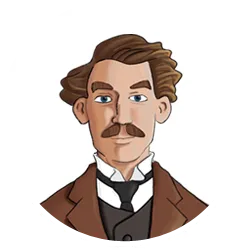
Samuel McIlhenny Knox was born in Gettysburg, Pennsylvania, in the United States of America, on the 21st May 1857, the son of John Charles and Margaret Ann Knox (née McIlhenny). His father was a farmer.
On completing his education, Samuel was employed as a life insurance agent and moved to Wilmington, Delaware. On the 18th June 1890, he married Florence Annie Pusey, and the couple had one child, a daughter named Jean. He became a director of his insurance company, and then served as a State Senator for Delaware from 1899 to 1903. He was a member of the Republican party.
He was also president of The New York Shipbuilding Company of 316, Upsal Street, Germanstown, New York, and in the spring of 1915, he embarked upon a business trip to England in the company of two friends, Mr. Fred Gauntlet, a Washington businessman and shipbuilder, and Mr. Albert Lloyd Hopkins, who was president of the Newport News Shipbuilding and Drydock Company. Their business was with the British Admiralty and was connected with the negotiation of a patent for a submarine design. Another source states that their business was connected with the manufacture of armour plate for warships.
Having booked saloon passage via the Philadelphia Office of The New York Shipbuilding Company, (with ticket number 14679), Samuel Knox joined the liner at the Cunard berth in New York harbour on the morning of 1st May. Once on board, he was escorted to room B9, which was the personal responsibility of First Class Bedroom
Steward Robert Morse, who came from Birkenhead, Cheshire, on the opposite bank of the River Mersey to Liverpool.
The liner’s departure for Liverpool was then delayed until the early afternoon, so that she could take on board passengers, cargo and crew from the Anchor Liner Cameronia, which had been requisitioned by the British Admiralty for war work as a troop ship. Then, six days later, on the afternoon of 7th May, the Lusitania was torpedoed twelve miles off the coast of southern Ireland by the German submarine U-20, and sank just eighteen minutes later. At that stage of her voyage, she was only 250 miles from the safety of her home port. Samuel Knox and Fred Gauntlet both survived this action, although Albert Hopkins was killed.
Having been thrown into the sea, or having jumped, when the liner went down, Samuel Knox was lucky enough to be able to swim to the wreckage of one of the collapsible lifeboats which had come adrift as the Lusitania sank. Coincidentally, he was helped on board by his friend and companion Fred Gauntlet and the boat was then taken under the command of Able Seaman Leslie Morton, who was able to rescue many people from the sea.
It is likely that Samuel Knox was transferred to a larger boat, either of the trawlers Peel 12 or H.M.S. Indian Empire, and then landed at Queenstown, from where he eventually got to England. It is not known whether or not he ever concluded his work with the Admiralty, but with Hopkins dead, Fred Gauntlet returned to America at the end of May, so it would seem unlikely.
Bedroom Steward Morse, who had looked after Samuel Knox in room B9, also survived the sinking and eventually made it back home to Birkenhead.
Samuel Knox died in Wilmington, Delaware, on 8th April 1924, aged 66 years, and his remains were interred at Ivy Hill Cemetery, Philadelphia, Pennsylvania. This was a few months before a claim for compensation he had filed for consideration with the Mixed Claims Commission was decided. By this time, his daughter had married a Mr. Chambers.
The Commission awarded his estate the sum of $15,000.00 in compensation for his injuries, and a further $1,330.00 for the loss of his personal belongings in the sinking.
Delaware Marriage Records 1744 – 1912, Delaware Deaths Records 1861 – 1933, 1860 U.S. Federal Census, 1870 U.S. Federal Census, 1880 U.S. Federal Census, 1900 U.S. Federal Census, 1910 U.S. Federal Census, 1920 U.S. Federal Census, U.S. Passport Applications 1795 – 1925, Cunard Records, Mixed Claims Commission Docket No. 619, Cork Examiner, New York Times, Last Voyage of the Lusitania, Seven Days to Disaster, PRO 22/71, PRO BT 100/345, Graham Maddocks, Geoff Whitfield, Michael Poirier, Jim Kalafus, Cliff Barry, Paul Latimer, Norman Gray.
Copyright © Peter Kelly.