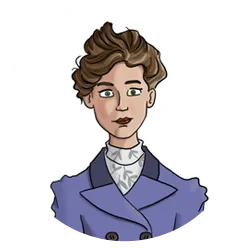
Sarah McLellan was born in Carsphairn, Kirkcudbrightshire, Scotland, in 1878, the daughter of Alexander and Jane McLellan (née McTaggart), later of Tongland Bridge, Barstibly, Kirkcudbright, Kirkcudbrightshire, Scotland. Her father was a ploughman. Sarah was the second eldest of nine known children, and on leaving school, became a domestic servant.
In May 1911, she went to Lake Forest, Illinois, in the United States of America, where her brother, William, was living and working. It is presumed that she found work there also.
In the Spring of 1915, she decided to return home to Scotland to see her family and friends. As a result, she booked as a second cabin passenger on the Lusitania and joined the liner at Pier 54, before she sailed from New York for the last time, on 1st May 1915.
She had made friends with another Scot from the same area, Miss Agnes Crosbie, who had also been staying in Illinois, but who was travelling as a third class passenger on the Lusitania.
When the liner was sunk, Miss McLellan managed to get into a lifeboat and was eventually landed at Queenstown where she was put up in a hotel for the night. The next day, whilst walking in Queenstown, she came across her friend Agnes Crosbie who had also managed to survive. Both of them had to be supplied with clothing for their journey home, however, as they had both lost all their belongings in the sinking.
They eventually arrived at Dumfries, in southern Scotland, at seven o’clock on the morning of Sunday, 9th May, but unable to get a train home that day, they both stayed with Sergeant McAdam of the Stewarty Constabulary, at nearby Maxwelltown. The sergeant was a cousin of Sarah McLellan. From there they both made it back to Kirkcudbright, the following day.
An account of her experiences appeared in The Dumfries and Galloway Standard for 12th May 1915. It stated: -
Miss McLellan was amongst the second class passengers, and she states that when the alarm was given, she ran to the high side of the vessel and had no trouble getting into one of the lifeboats. It contained sixty-three persons in all, nineteen women, ten children and the remainder men. The survivors had a very trying experience. The lifeboat was found to be leaking, and it took in water so badly that in addition to the ordinary
ladle provided for baling purposes, a hat and a shoe were amongst the other articles used by the survivors in order to keep the boat from filling with water. A fishing smack was at last sighted, and the lifeboat was taken in tow.
It is likely that the lifeboat referred to by Miss McLellan was Lifeboat No. 13, which was taken in tow by a fishing smack and eventually transferred its passengers to the Queenstown harbour tender Flying Fish for landing at Queenstown. The account concluded: -
Miss McLellan states that amongst her fellow passengers on the Lusitania was Miss Nichol, sister-in-law of Dean Mogerley, Dumfries. On the Wednesday before the disaster, a concert in aid of the Sailors’ Orphan Fund was being organised amongst the second class passengers, and Miss Nichol had been awarded a silver photograph frame as a prize for selling most programmes.
She did not see Miss Nichol at the time of the disaster, and on landing at Queenstown, she was unable to find her amongst the survivors.
In fact Miss Nichol was fellow second cabin passenger Mary F. Nicol, travelling from Chicago, who was killed after the liner was struck and whose body was never recovered and identified afterwards.
Not long after her return home, Sarah McLellan applied for financial help to The Lusitania Relief Fund. This fund had been set up immediately after the liner had gone down, by The Lord Mayor of Liverpool and other local business dignitaries to help second and third class passenger survivors and the relatives of those who had perished, who had come upon hard times as a result of the sinking. It was thought that saloon class passengers were wealthy enough not to need help and each claim was met on its merits.
The awards committee declined to award her any money, however, on the ground that there was no apparent need, as she decided to return to Illinois!
On the 22nd September 1915, Sarah McLellan board the St. Paul at Liverpool, arriving safely in New York City eight days later, and from there she made her way back to Lake Forest.
On the 11th May 1916, she married Henry Skinner Duncan in Lake Forest. Henry was a widower, with two young children – Mildred and Leonard, his wife having died in 1914. He worked as a yard superintendent for M.H. Hussey & Company, in Lake Forest. The couple had two children – Henry J., born in December 1916, and Alexander, born in December 1920.
On the 15th August 1942, her eldest son, Henry, enlisted in the U.S. Army. As 36603738 Private First Class H. Duncan, he was killed in action in Germany on the 24th March 1945, whilst serving with Company “L”, 415th Infantry Regiment, 104th Infantry Division. He was aged 28 years.
Sarah Duncan died at Lake Forest on the 4th July 1952, aged 73 years. Her remains were interred in Lake Forest Cemetery.
1881 Census of Scotland, 1891 Census of Scotland, 1901 Census of Scotland, 1920 U.S. Federal Census, 1930 U.S. Federal Census, 1940 U.S. Federal Census, New York Passenger Lists 1820 – 1957, Cunard Records, U.S. World War I Draft Registration Cards 1917 – 1918, Dundee Peoples Journal, Dumfries and Galloway Standard and Advertiser, Westmoreland Gazette, Liverpool Record Office, Graham Maddocks, Geoff Whitfield, Michael Poirier, Jim Kalafus, Cliff Barry, Paul Latimer, Norman Gray.
Copyright © Peter Kelly.