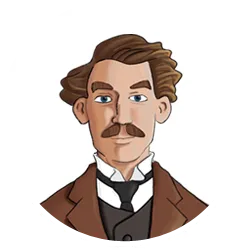
Anton Siguard Jacobæus was born in the parish of Skarhult, Skåne, Sweden, on the 16th March 1868, the son of Anton Christian and Lykke Catherine Marie Jacobæus, (née Jacobæus!). His father was described as being a “gentleman farmer”, and Anton was the eldest of five children.
By 1890, Anton was a supervisor at Tulesbo Manor, where he lived with his family, and it is believed that from around 1900, he was leasing the property. By now, he was being described as an agriculturalist, and on the 7th September 1901, he married Ebba Frost at St. Petri, Malmo, Skåne. The couple had no children, and it is believed that they divorced in 1903.
On the 7th May 1907, he married Karen Hagen in the Kristian Kirke, Copenhagen, Denmark. In 1912, the couple fostered a child, named Nils Olaf, who was born in 1910, but they had no children themselves. Following their marriage, Karen went to live with Anton in Tulesbo Manor.
By early 1915, Anton was experiencing difficulties in his life. According to Swedish newspaper reports, he had engaged in bad business dealings and was neglecting Tulesbo Manor, to the point where it had fallen into disrepair, and it was rumoured that he had been forced to leave it. He was also reported to have been travelling extensively, spending a lot of money as he did so.
Then, it was reported that he had mysteriously disappeared from his home on the 31st March 1915, taking a large sum of money with him, including 10,000 Swedish Krona, which he had borrowed from a bank. In total, it is believed that he was in possession of about 30,000 Swedish Krona (£1,200 approximately) when he disappeared.
On the 3rd April 1915, he boarded the S.S. United States at Kristiania (now Oslo), Norway, and disembarked in New York City on the 16th April. On arrival in New York City, he gave his occupation as being involved in real estate, and stated that he was intending to travel to a friend, named Mr. Brown, who resided in Medicine Hat, Alberta, Canada. He did cross the border into Canada, but it is not known if he reached his friend in Medicine Hat.
He did not remain long in Canada, because he booked a saloon passage, (through a Chicago travel agency), on the sailing of the
Lusitania which was scheduled to leave New York on the morning of 1st May. He then arrived at the Cunard berth, at Pier 54 in New York harbour on May Day morning, and with ticket number 1686, was escorted to room E60, which was under the control of First Class Bedroom Steward David Critchley, who came from Bootle, Lancashire, on the outskirts of Liverpool.
The Cunarder finally left her berth just after mid-day after a delayed start so that she could take on board passengers, crew and cargo from the Anchor Liner
Cameronia which the British Admiralty had requisitioned for use as a troop ship at the end of the previous month. Then, six days later, on the afternoon of 7th May, Anton Jacobæus was dead - killed after the
Lusitania was torpedoed and sunk off The Old Head of Kinsale in southern Ireland, by the German submarine
U-20, only 250 miles away from her home port of Liverpool. He was aged 47 years.
His body was recovered from the sea fairly soon after the sinking, however, and having been landed at Queenstown, it was taken to one of the temporary mortuaries set up there, where it was given the reference number 84 and described as: -
Male 55 years, 5’11“. Hair turning grey, moustache, long face and head, very stout, black clothes.
Once it had been identified, however, it was buried on 10th May 1915 in The Old Church Cemetery, in Mass Grave C, 6th Row, Lower Tier. It was on this day that most of the dead from the sinking were buried after a long funeral procession which began outside the Cunard offices at Lynch’s Quay on the waterfront at Queenstown.
Property recovered from Anton Jacobæus’ body, which probably aided its identification, was eventually sent to his Swedish home. It was reported in some quarters that 25,000 Swedish Krona, and his gold watch, were recovered from his body.
As it was necessary to bury all the recovered bodies as soon as was practicable, for reasons of hygiene, they were all photographed in the temporary mortuaries in Queenstown before being buried. Anxious relatives of those missing were then invited to identify their loved ones through these photographs. This was difficult in certain cases because of injuries they had sustained as a consequence of the sinking or because they had been in the water for a long time. The photographs of the bodies were displayed not long after the sinking in St. George’s Hall, Liverpool and Mrs. Christina Limburg the widow of Confectioner Frederick Limburg must have seen them there as later, she wrote to Cunard for more details of corpse number 84, whom she thought might have been that of her husband.
Cunard wrote back to her with the following description: -
40 years old, Height 6’ 2” Eyes large blue, Cheek bones high, Deep mark across nose. Third finger of left hand has the first joint off.
From this, Mrs. Limburg realised that it was not her husband’s body after all by which time it had already been identified as that of Anton Jacobæus.
Bedroom Steward Critchley, who had looked after Jacobæus in room E60, was also killed in the sinking and never saw his Bootle home again.
On 21st June 1916, administration of Anton Jacobæus’ estate in England was granted to Martin Waldenstein, who was an advocate and his effects amounted to £96-6s-8d., (£96.33p.). Two days later, a representative of the firm of Kearney, Howes and Williamson of 108, Cannon Street, London signed on his family’s behalf for £91-16s-0d., (£91.80p.), which represented the sum total of monies and drafts that Jacobæus was known to have been carrying and which were presumably recovered from his body.
Friends of Anton Jacobæus believed that when he disappeared it was his intention to travel to South Africa, via Berlin, but for some unknown reason, he had travelled north into Norway, boarded the
United States, disembarked in New York City, travelled briefly into Canada, and then returned to New York to board the
Lusitania. They speculated that once he had reached Liverpool, he would have boarded a liner sailing to South Africa.
Sweden Indexed Marriage Records 1860 – 1943, Sweden Select Marriages 1630 – 1920, Denmark Church Records 1812 – 1918, New York Passenger Lists 1820 – 1957, Canadian Passenger Lists 1965 – 1935, Cunard Records, Probate Records, PRO 22/71, PRO BT 100/345, UniLiv.D92/1/8-10, UniLiv D92/2/88, UniLiv D92/2/271, Deaths at Sea 1871 – 1968, Graham Maddocks, Denise Deighton, Peter Engberg-Klarström, Geoff Whitfield, Michael Poirier, Jim Kalafus, Cliff Barry, Paul Latimer, Norman Gray.
Copyright © Peter Kelly.