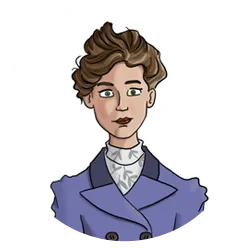
Theodate Pope was born in Salem, Columbiana County, Ohio, in the United States of America, on 3rd February 1867, the daughter of Alfred Atmore and Ada Lunette Pope, (née Brooks). Her father, who had been born in 1842, was a successful iron manufacturer in Cleveland, Ohio, and he had made most of his fortune making railway lines for the booming railroad systems of the nineteenth century.
Theodate Pope was christened Effie Pope, but as she grew older, she thought that this name was not serious enough and changed her name to Theodate, after one of her grandmothers, Theodate Stackpole. The family home was at Farmington, Connecticut.
She was educated at Miss Porter’s School, Farmington, after which, in the 1880’s, she spent some time with her family, touring Europe where she first fell in love with architecture and her father first found an interest in impressionist paintings.
On her return, Theodate Pope studied architecture at The College of New Jersey and became one of the first female architects in America - and certainly one of the best. Her first works were the restoration of an eighteenth century farmhouse, but one of her most important commissions was to build a home for her parents in Farmington, in conjunction with renowned architect Stanford White of the firm of McKim, Mead and White. It was called ‘Hill-Stead’ and was used by her father to house his growing collection of paintings and fine art. After this, she went on to design Westover School for Girls in Connecticut, several country estates, and she also took on the re-design of Theodore Roosevelt’s birth place in Manhattan.
She was also passionately interested in the study of psychical research and in the spring of 1915, decided to travel to London with fellow Farmington psychic devotee, Edwin Friend, to attend an international spiritualist meeting there. She was to be the guest, in England, of Sir Oliver Lodge, a noted English spiritualist.
Consequently, she booked saloon class passage across the Atlantic on the Lusitania, and travelling from Washington, D.C., at the end of April; she arrived in New York and booked in at The Renaissance Hotel, at 512. 12th Avenue. She joined the liner on the morning of 1st May at the Cunard berth at Pier 54, in New York harbour.
Once on board, (with ticket number 46015), she was escorted to room D54, which was under the personal supervision of First Class Bedroom Steward William Barnes, who came from Wallasey, on the opposite bank of the River Mersey from Liverpool. She shared the room with 38 year old Miss Emily Robinson, who was her personal maid.
Throughout the time after the liner had left New York, Theodate Pope and Edwin Friend were constant companions and they were together, having just finished lunch, when Schwieger’s torpedo struck the Lusitania, on the early afternoon of 7th May. According to the authors Adolf and Mary Hoehling in their book The Last Voyage of the Lusitania: -
Half-way around the corner of the promenade deck outside the smoking-room Theodate Pope and Edwin Friend paused, looked at each other. The sound of the explosion had been clear and unmistakable. When the water and timbers “flew” past the deck, Friend struck his fist in his hand and exclaimed : “By Jove, they’ve got us!”
Just as the two rushed into a small corridor, the ship listed so heavily that both were thrown against a wall. But they missed the shower of soot which cascaded to the deck. They recovered their balance and started towards the boat deck, where they had previously arranged with others to meet in the event of an emergency.
Realising that the ship was inevitably going to sink, both knew that their best chance of survival was to get into a lifeboat, but Miss Pope refused to enter one without
Edwin Friend, and he in turn would not set foot in one when there were still women left on deck!
Making their way towards the stern, as the bow was obviously sinking, Friend managed to secure lifebelts for himself, Miss Pope, and Miss Robinson. The Hoehlings describe what happened next: -
Friend tied the belts on the women and they stood by the ropes on the outer side of the deck in the place one of the boats had occupied. They looked up at the leaning funnels and could see the ship move. “She was going rapidly.”
Now they could see the grey hull, once hidden, where the water-line began. It looked like the underbelly of a great whale. It was time to jump. “You go first,” Theodate said.
Friend stepped over the ropes, slipped down one of the uprights, and reached the rail of B Deck, next lower. Then he jumped. The two women waited for Friend to come up. In a few seconds they were relieved to see his head bobbing in the foamy water, then he smiled to encourage them.
“Come, Robinson,” Theodate said and stepped over the ropes as Edwin Friend had before her. She slipped a short distance, found a foothold on a roll of canvas used for deck shields, then jumped. She feared that her maid would not follow her.
She could not reach the surface. She was being washed and whirled up against something that felt like wood. Then she opened her eyes and blinked in the green water-through the murk it looked as though she were being dashed up against a lifeboat keel.
"This of course is the end of life for me," she thought as she closed her eyes again. She flailed her arms in a half-spirited attempt to come to the surface. She thought of her mother and was glad she had made a will. She started to count all the buildings she had designed - the ones built and building - and hoped she had "made good".
Quietly she thought of the friends she loved, then committed herself, in "a prayer without words", to God's care. She received a sudden blow on the head, felt it crashing through the straw hat she still wore, and lapsed into unconsciousness. .....
She regained consciousness in a "grey world". While the blow had been cushioned by her straw hat and her hair, it had temporarily affected her sight. She could not see sunlight although she was certain that she was on the surface.
Gradually she became aware that she was surrounded and jostled by hundreds of frantic, screaming humans in her "watery inferno". A man, insane with fright, had affixed himself to her shoulders. Half dazed as she
was, Theodate recognized the panic in his eyes as he stared wildly over her head. He had no lifebelt and his weight was pulling her under again. She was too tired to struggle against him, which might have made him cling all the more tightly. "Oh, please don't," she implored. Then the water closed over her and she lapsed back into unconsciousness.
When she opened her eyes a second time she was floating on her back, staring into brilliant sunlight and blue sky. The man had gone. Other men and women were floating about her, but at increasing distances. She noticed a man on her right with a gash on his forehead; close by she could make out the back of a woman's head. At her left was a peculiar sight - “an old man upright in the water". His life-jacket must have been exceptionally buoyant for he was treading water.
Since he seemed to occupy an elevated position, with the horizon surely in his sight, she asked him: "Do you see any rescue ships coming?" He said, "No," after a look around. An Italian with his arms girdling a small tin tank floated by, chanting. There were occasional shouts, and somewhere in the background the discordant singing of "Tipperary".
Ship's boats, far away, all appeared crowded. Theodate wondered where Edwin Friend was. The water felt warm and it occurred to her she might be able to remain afloat some time. Then an oar bobbed by; she took hold of one end, pushing the other to the old man who was half standing at her left.
Now the increasing weight of her soaked clothes was dragging her down. She lifted her right foot over the oar blade and held it with her left hand. This improved her buoyancy and she did not have to exhaust her dwindling energy to keep afloat. She tried to raise her head to see if rescue were on the way. Then she sank back, wearied from the effort. Thinking it "too horrible to be true", she soon lost consciousness. .....
At evening Theodate Pope was discovered by the trawler Julia, almost down to its scuppers with survivors, as well as with those who did not survive. Theodate, kept afloat by an oar; was unconscious. Sailors fished her up with boat hooks and laid her on the deck among the dead.
An acquaintance of the voyage, Mrs. Theodore Naisch, of Kansas City, Missouri, recognized Theodate. She just had a hunch there might be a spark of life there, even though Theodate was stiff and cold from the salt water and felt to the other woman's touch "like a sack of cement".
Mrs. Naisch persuaded two sailors to give Miss Pope artificial respiration. They cut her clothing off with a carving knife and worked patiently for nearly two hours. Finally her breathing became steady, although she remained semi-conscious for another hour or two. They wrapped her in a blanket and placed her on the floor before the charcoal fire in the captain's cabin.
It was almost ten-thirty that night when Theodate became aware of the small open-grate fire and a pair of grey-trousered legs beside it. Turning her head, which still ached horribly from the blow she had received in the water, she raised her eyes and saw a man leaning over a table, looking at her.
"She's conscious," she heard him say. Two women patted her and said the doctor was on his way. Theodate asked the women their names, then realized what an effort it was to talk. She was shaking violently despite the heat from the fire, had no idea where she was nor any recollection of the shipwreck.
When finally the Julia came alongside, a doctor stepped aboard. He examined Theodate Pope in the captain's cabin, then called two sailors to assist her ashore. They made a chair out of their locked hands. Failing to hold on to their shoulders as they lifted her, she almost fell over backwards. The doctor came up behind them and steadied her as they started towards the gangplank. "Way, way!" one of the sailors shouted at the curious Queenstown citizens.
She was then taken to a hotel somewhere in Queenstown, which she had to share with many other survivors. Still in shock from the cold and her ordeal she hardly slept, despite what must have been almost total exhaustion. It was not long after this that she noticed that her hair was starting to fall out as she was still in shock and very badly stunned by her experience.
From the hotel in Queenstown, she was eventually taken to an address in Cork, where she was looked after in a sort of semi-private hospital, by a family well known in the area for their hospitality. Local newspaper, The Cork Advertiser, in its morning edition of Thursday 13th May 1915, told of her ordeal for survival and a subsequent coincidental re-union: -
There are at present staying with a gentleman - a well known Cork citizen - and his family, two ladies, victims of the Lusitania disaster, who were brought together under rather dramatic circumstances. One of the ladies is a Mrs. Nash, (sic) who unfortunately lost her husband and the other a Miss Pope.
Neither were acquainted when on board the ship. After the explosion, Mrs. Nash was in the water a comparatively short time when she managed to climb on to an upturned boat, and sat there with thirteen others for some hours before she was picked up by a boat which came out from Queenstown.
Having been safely got on board, the boat proceeded on its search for bodies, dead or alive, and one of the last to be picked up was that of a lady whom the crew thought was dead. The captain of the boat asked Mrs. Nash to assist in the work of resuscitation. This she did, and ultimately the lady was brought back to consciousness.
As we have already seen, Belle Naisch - not Nash, - although presumably her surname was pronounced in this manner - did in fact know Theodate Pope as she recognised her on the Julia, which probably helped to save her life.
Both ladies were landed at Queenstown with the rest of the survivors, and stayed in different hotels. The gentleman in question being interested in helping the survivors, happened to visit these two ladies. He invited them to his house and there Miss Pope recognised Mrs. Nash as the lady who helped to restore her to life. It was a pleasant meeting after such direful experiences.
After a time, Theodate Pope made a full recovery and completed her journey to England, alone, as both of her companions, Edwin Friend, and her maid, Emily Robinson, were killed in the disaster and nothing more was ever seen or heard of either of them again! Bedroom Steward Barnes, who had looked after Miss Pope and Miss Robinson in room D54 did survive the sinking, however, and eventually got back to his Wallasey home.
She eventually returned to America, and exactly one day short of the first anniversary of the Lusitania sinking, on the 6th May 1916, Theodate Pope married John Wallace Riddle, in Farmington. He was a member of the United States Diplomatic Service and former United States Ambassador to Russia. She later accompanied him when he was appointed United States Ambassador to the Argentine. In 1925, she was awarded $25,000 for suffering and discomfort occasioned by the sinking and a further $4,850 for the loss of her jewellery and personal belongings, by the Mixed Claims Commission.
Throughout the rest of her life, she pursued a professional interest in architecture and was especially involved with a large project known as Avon Old Farms School which was a progressive preparatory school for boys which consisted of 25 ivy-covered buildings in an English rural style. Today, the school is used as a convalescent home for blinded war veterans.
After a long and eventful life, Theodate Riddle died in Farmington on the 30th August 1946, aged 79 years, and was buried in Riverside Cemetery, Farmington. He husband had died in 1941.
In her will, she left ‘Hill-Stead‘, with all it contents - which by then included works by Manet, Monet, Degas and Whistler - as a museum, on the condition that nothing was moved, sold, lent or labelled!
1870 U.S. Federal Census, 1880 U.S. Federal Census, 1900 U.S. Federal Census, 1910 U.S. Federal Census, 1920 U.S. Federal Census, 1930 U.S. Federal Census, 1940 U.S. Federal Census, U.S. Passport Applications 1795 – 1925, New York Passenger Lists 1820 – 1957, Cunard Records, Mixed Claims Commission Docket No. 580, IWM GB62, Connecticut Women's Hall of Fame, Cork Examiner, South Coast Today, The Kane Republican, Last Voyage of the Lusitania, Seven Days to Disaster, PRO 22/7, PRO BT 100/345, Deaths at Sea 1871 – 1968, Graham Maddocks, Geoff Whitfield, Michael Poirier, Jim Kalafus, Cliff Barry, Paul Latimer, Norman Gray.
Copyright © Peter Kelly.