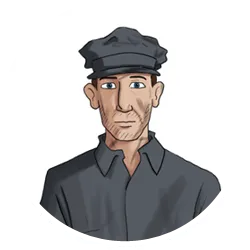
Thomas Madden was born in Kilglass, Strokestown, County Roscommon, Ireland on the 11th August 1873, the son of Thomas and Margaret Madden (née Kelly). As far as can be ascertained, he was the eldest of seven children, and his family were farmers.
It is not known when he crossed the Irish Sea to settle in Liverpool, Lancashire, England, but he became a professional seaman in the Mercantile Marine as a fireman on steam ships operating out of the port of Liverpool.
In 1906, he married Mary Burke in Liverpool, and it not believed they had any children.
Sometime after their marriage, the couple moved to New York City in the United States of America, where Thomas worked as a labourer in a U.S. Navy facility, while his wife worked as a clerk in what was described as a “card house”.
After a few years, they returned to Liverpool where Thomas returned to working as a fireman on steam ships. By 1915, they lived at 40, Rhyl Street, Bootle, Liverpool.
Thomas Madden signed on as a fireman in the Engineering Department on board the Lusitania, at Liverpool, on the 12th April 1915. His monthly rate of pay of £6-10s.-0d. (£6.50p.). His previous ship had been the White Star ship Arabic. He reported for duty at 8 a.m. on the 17th April, before the Lusitania’s left Princess Landing stage for the last time.
He survived the sinking and having been rescued from the sea was landed at Queenstown, and on his eventual return to Liverpool, he was officially discharged from
the Lusitania’s final voyage and paid the balance of wages owing to him which amounted to £4-14s.-0d. (£4.70p.).
On the 17th June 1915, Thomas Madden was called as a witness on the third day of the British Wreck Commissioners Inquiry into the sinking of the Lusitania, which was presided over by Lord Mersey. He was examined by Mr. Branson, although his evidence was brief: -
Were you a fireman on board the “Lusitania”?
Yes.
Were you in the No. 1 stokehold on the 12 to 4 watch on the day of this disaster?
Yes.
Were you working at the centre boiler on the port side of the ship?
Yes.
As you were working there did you hear an explosion?
Yes.
Where did you think the explosion came from?
I thought it came from the forward end on the starboard side, from the forward side of the starboard boiler.
Did water come into the boiler room?
Yes.
How soon after you heard the explosion?
About 2 or 3 minutes.
Was it much water?
Well, I ran to the watertight door, that was shut down, and by the time I got back it was coming through the boilers. There would be about a foot and a half then.
Then I think you got to the escape ladder and up the ventilator?
Yes.
And fortunately you were rescued?
Yes.
In the 1920’s, Thomas and his wife returned to New York, where he applied to become a naturalized U.S. citizen in 1923. The couple resided at 446. West 14th Street, in New York City. It is not known if Thomas Madden completed the process to become a naturalized U.S. citizen, but in 1929, the couple permanently returned to Liverpool and resided at 60. Rhyl Street, before moving to 3. Hoggs Hill Lane, Formby, Lancashire.
Nothing is further known about him.
Register of Births, Marriages and Deaths, Irish Catholic Parish Registers 1655 – 1915, 1910 U.S. Federal Census, 1939 Register, New York U.S. State and Federal Naturalization Records 1794 – 1943, New York Passenger Lists 1820 – 1957, UK Incoming Passenger Lists 1878 – 1960, Cunard Records, PRO BT 100/345, PRO BT 350, PRO BT 351/1/86579, Graham Maddocks, Geoff Whitfield, Michael Poirier, Jim Kalafus, Cliff Barry, Paul Latimer, Norman Gray.
Copyright © Peter Kelly.
Revised & Updated – 1st April 2024.