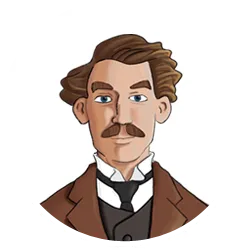
William Uno Meriheina was born in Helsingfors (Helsinki), Finland, then part of Imperial Russia, on the 15th July 1888, the son of Karl G. and Charlotta Meriheina (née Malvenius). His father was a decorator, and William was the second eldest of three boys born before the family immigrated to the United States of America.
In 1892, his father travelled to the United States of America, and after establishing himself in business as K. G. Meriheina & Company, “House, Sign & Fresco Painters”, at 85. Mechanic Street, Fitchburg, Massachusetts, his wife and three sons joined him in 1893. By 1900, the family had moved to Eight Avenue, Manhattan, New York City, and changed their family name to “Heina”, with William often using his birth family name, and at other times the name “Heina” and “Merry Heina”!
On completing his education, William found work driving a taxicab in New York City, and on the 14th July 1909, he married Esther A. Griffin in Manhattan. Initially, the couple lived with Esther’s parents, with their daughter, Charlotte, born in 1910.
In 1909, William distinguished himself in automobile races at Brighton Beach, and joined the Lozier car company racing team. He participated in the inaugural events that would develop into the Indianapolis 500, and suffered a serious leg injury during a race at Brighton Beach in August 1909.
He also became involved in aviation, qualifying as a pilot, and taking, then, Lieutenant Colonel Cornelius Vanderbilt III on the latter’s first eight-minute flight at Hempstead Pain Aviation Field. In addition, he was developing his skills as an inventor, patenting designs for axles for motor vehicles, and patches for tyres.
William became a sales representative for The General Motors Export Company, based at 11, Broadway, in New York City, and in August 1914, he patented an improved automobile tyre of his own design. In March 1915, he established the Meriheina Tire Company to manufacture his new tyre and wheel rims, having Ernest Derks and Edward Kammler as his partners in the business. The company was established with $15,000 stock capital, and William Meriheina became a silent partner, continuing his involvement with The General Motors Export Company.
In early 1915, he was appointed the South African representative of The General Motors Export Company, and leaving his family in New York, he prepared to set off for South Africa. For the first part of his journey there, he was booked as a second cabin passenger on the May sailing of the Lusitania from New York to Liverpool.
Having arrived at the Cunard berth at Pier 54 on the morning of 1st May 1915, in time for the liner’s scheduled 10.00 a.m. sailing, he boarded, but in common with all her passengers and crew, he then had to wait until 12.27 p.m. before the liner actually left her moorings and slipped into the North River to begin her last voyage. The delay was because she had to take on board passengers, cargo and crew from the Anchor Liner Cameronia, which had been requisitioned by the British Admiralty for war work as a troop ship.
Mr. Meriheina kept a short, daily diary, for a few days at least, in which he recorded his thoughts, experiences, and routine: -
The Lusitania. Saturday. On the way out of New York Harbor, and everything O.K. At Ambrose Lightship we pass the British man of war Bristol; then we sight the British converted cruiser Caronia. We stop, and a boat load of “Tommy Atkins” comes on board, presumably for mail and exchange of messages. No wireless is used. Received wireless from General Motors Company. When I said that no wireless is used, I meant that we receive messages but can’t send any. Later in the afternoon, we passed the American Line steamship New York, also bound for Liverpool. Then we sighted a French battle cruiser of the super-dreadnought type, and this cruiser turned and followed us, but gradually was left behind. We are making about twenty five miles per hour.
Had a grand time at lunch and dinner. What delayed our start was the fact that the Anchor Line sent up about 300 passengers that were booked to go on one of their ships, and at the last minute the ship was called out of passenger service, presumably for transport purposes.
Feel fine, and am going to sleep well.
Sunday - Woke up, had a dandy salt water bath. Enjoyed a grand breakfast. Sunday services were held on board. Foggy day, and quite rough ocean. At noon Sunday our log recorded 453 miles, or halfway to Newfoundland Grand Banks. Day passed with concerts in the drawing room. Plenty of seasickness on board, but I feel splendid. Lunch and supper fine. Because of rough weather nearly everyone turned in quite early. At midnight, I understand we passed a British cruiser. I noticed a great deal of light signalling going on. Evidently we are being carefully convoyed all the way across. Still, no ships are in sight for any length of time. We have passed quite a few vessels bound both ways. Owing to our great speed, we don’t stay in sight of any one ship very long.
Monday – Feeling great. Fog is prevalent. Dandy meals – passed a bunch of ships. We had a concert, games, races, and drive whist, and various other entertainments. Am enclosing today ocean newspaper. Rolling quite a little, but am not affected in the slightest. Have an M.D. – surgeon – as a room mate. We have become quite good friends. He is going to offer his services to the Allies as a surgeon. He is Dr. D.V. Moore. He is well educated and provides a good, companionable, room
mate. Am acquiring an extensive knowledge of Scotch, English, and Irish dialects and you must not be surprised if I talk funny when I come back to you. Several of the passengers are grand singers, and they keep everyone interested. I am studying my work, and I think my trip will do me good.
Tuesday – resumption of games on deck today. Dandy sunshine weather – feel fine.
He made no entries in his diary after this.
Then, six days out of New York on the afternoon of 7th May, the Lusitania was torpedoed twelve miles off the coast of southern Ireland by the German submarine U-20. At that stage of her voyage, she was only about 250 miles from the safety of her home port.
After the liner sank - only 18 minutes after the fatal blow, William Meriheina found himself in the water, having helped to get some fifteen women and children into lifeboats. Being a strong swimmer, he was able to support himself for some three hours before he managed to get on to a floating raft. After a further two hours, he was rescued from the sea and eventually landed at Queenstown. Altogether there were 68 Russian passengers on the Lusitania, and of these, 39 were killed and only 29 survived the sinking.
After he managed to get on the raft, he wrote on two postcards, depicting the Second Cabin Drawing Room of the Lusitania, which he had in his possession: -
Ship Sunk. Seventy of us on a raft. Believe the lost will amount to half of our passengers. May we all be happy in our destiny.
Steamship coming: also sail boats. Hope most of us will be saved. Tis a conquest of kings. May they be glorified by a crown of life and death. Hopes the lives of the lost ones will pay the score.
Some surviving Russian nationals were later to complain to their Consul General in Liverpool about the poor treatment they received at the hands of the authorities in Queenstown and it is to be hoped that Mr. Meriheina was not one of these.
William Meriheina remained in the Queens Hotel in Queenstown for a number of days following his rescue, and while there, he wrote a letter to his wife, recounting his experience and the contents of the letter also formed the report he sent back to The General Motors Export Company. He wrote: -
The terrible crash finally came. First, I will say that outside of a few bruises and pains and exhaustion, chills and fever, etc., I am feeling fine. Am stopping at this hotel and will probably remain here for a few days till I feel right again.
We were eating lunch at the time, when suddenly, with absolutely no warning, we felt a heavy explosion up forward, near the first cabin section, a grinding and a ripping. The boat immediately lurched to the side you were looking at as we were tied to the New York dock. She settled so much that dishes fell off the tables and it was difficult to walk
the aisle between tables. There was very little panic – individuals moaned and cried and just the suggestion of a rush for the exits. Those that left the second cabin dining room probably were the ones that were saved, mostly.
About five seconds after the first crash, a second one came along, with the same sinking sensation on the one side. The men did a great deal for the women and children, but remember the boat sank to the bottom in less than twenty minutes, and after the first ten minutes the boat had rolled over so that the side was more level than the decks. The lifeboats that were lowered were either overturned or smashed against the side of the boat, dumping the human loads into the ocean. I don’t pretend to describe the total scene, it was too horrible, but I did everything I could to help the women off. I placed a life belt on myself, and placed several elderly women in life rafts that might tear loose from the decks when the boat sank, which they finally did. The people who reached the decks were the only ones saved, as the ship sank in a flash when she finally started nose downward. On sinking, her boilers blew up and her deck roofs blew off. I had faith in the boat not sinking and therefore remained on the back bridge till I was washed off.
The internal pressure created in the hull by the inrush of water was sufficient to blow out port hole plates, and the air shot out of these like steam. I saw many bodies floating away deep in the water.
The sight of people falling overboard and sinking, with apparently no effort to swim, was maddening. Well, when the final plunge came, I believe that I was the last, or one of the very last, to get off. I tried to jump, but got fouled by the angle of the deck and the rail posts, and was washed off only to be slammed back downward with the hull. I lost consciousness and then came to with the bright sun shining in my eyes. It was cold and I felt stunned, but I struck out for an overturned lifeboat that was about a city block away. There were people all around, both live and drowned. On reaching the boat, I hung on to the side of the rope for a minute or so, when a man grabbed my neck, placed his arm over my shoulders, and pulled me off. I turned and hit him. He weighed over 200 pounds and I could not shake him off, so I sank purposefully and he let go at once. I again reached the boat and the man also had a finger grip on the rope. Several others were hanging on. One after another we managed to climb up on the slippery sides and lie on its keel. I finally reached out and helped this particular man up on the boat and also several others. We finally had about twenty men and women on the overturned lifeboat and she threatened to sink, when another overturned lifeboat came near and some of the men made for it. We kept those two overturned lifeboats together, loaded with humans half dead, and some dead.
Then a broken raft was forced near us, and we placed all the women and children thereon. Right near us was an upright lifeboat, but entirely submerged so that only the oarlocks were visible at times. This boat
contained about a half dozen women and twenty men. We finally got the women off her on the raft, and the men remained, several drowning therein. We had a lot of trouble with our crew of these two overturned lifeboats – the crew, I mean, were the people thereon. Some wanted to paddle to shore, which looked twenty miles off, and others wanted to save their strength. We sang “Tipperary” a couple of times (sacrilege) and then due to the women’s crying, and begging us to stop, we sang “Lead, Kindly Light”, men were bleeding and injured.
Then after three and one half hours, the fleet from Queenstown came into view. They picked up most of the other boats first, as we were farthest away, and then finally came to us. All this time we were constantly adding to our crew and settling deeper and deeper. In the three and one half hours agony I found time to take out my fountain pen, which I still had, and dug out a couple of wet post cards that I obtained previously from the drawing room of the boat. I wrote my impressions very mildly on two of them. The rest of my time was taken up either pumping arms up and down, or squeezing some poor “half gone’s” wet clothing. We finally had more than 70 on our improvised raft. Then they picked us up. The Indian Empire was our rescue boat.
Dr Moore, who shared a cabin with William Meriheina, also survived. Mr. Meriheina eventually managed to reach his destination in Johannesburg, South Africa. The Queens Hotel, where Mr. Meriheina stayed, continues to trade today, however, it is now known as the Commodore Hotel.
In 1916, he returned on holiday to his wife and daughter, who were now residing at 506. West 134th Street, New York City, and in 1917, he permanently returned to New York City. He petitioned to become a naturalized U.S. citizen on the 17th October 1917, in the name of William Merry Heina, his application being successful, and from then on, he never used the name “Meriheina” again.
Another survivor of the disaster was saloon class passenger, C.T. Jeffrey, who had inherited the “Rambler Motor Car Company”, and rebranded the company “Jeffrey”, in honour of his father. In 1917, the company was purchased by Charles Nash, the former president of The General Motors Company, who rebranded the company as “Nash”, and shortly after William Merry Heina returned from South Africa in 1917, he was travelling throughout the United States of America, selling “Nash” vehicles.
Sometime between 1920 and 1925, William and his wife, Esther, divorced. It was during this period that he set about designing and building commercial radio sets to be fitted and operated in motor vehicles. The difficulty at that time was that the static electricity from the electrical systems in vehicles interfered with radio signals, so radios that were fitted in vehicles could only be used when the vehicle was not operating. This meant that they were useless while vehicles were running! William patented a number of inventions which overcame this problem, and established a new business, named “Heinaphone” in Queens Boulevard, Woodside, New York City.
He patented the first commercially available, interference-free vehicle radio in 1926, and more refinements and patents followed, until Heinaphone merged with the
American Radio Corporation in 1927. The merged companies became “Traveltone”, and their radios being branded as “Transitone”. William Merry Heina was appointed vice-president of the company.
William Merry Heina dabbled in many fields, and his inventions are varied. As well as the automobile industry, he patented inventions in aviation, and even eyes for mannequins and dolls!
In the early 1930’s, he re-married, his second wife being Catherine “Kitty” Tuffy, but no other details are known about her. They lived for a time in Rochester, Nevada, and then Santa Monica, California.
By 1940, and probably for the duration of World War II, William was listed as an aircraft inspector.
He died in Valrico, Florida, on the 12th December 1976, aged 88 Years. His remains were interred in Gulf Pines Memorial Park, Englewood, Sarasota County, Florida, beside his second wife, Catherine, who had died in 1968.
New York U.S. Marriage License Indexes 1907 – 2018, Florida U.S. Death Index 1877 – 1998, 1900 U.S. Federal Census, 1905 New York State Census, 1910 U.S. Federal Census, 1920 U.S. Federal Census, 1940 U.S. Federal Census, Baltimore Passenger Lists 1820 – 1964, Pennsylvania Passenger Lists 1800 – 1962, Cunard Records, U.S. World War I Draft Registration Cards 1917 – 1918, U.S. World War II Draft Registration Cards 1942, New York Times, Pittsburgh Post-Gazette, Gare Maritime, Graham Maddocks, Geoff Whitfield, Michael Poirier, Jim Kalafus, Cliff Barry, Paul Latimer, Peter Engberg-Klarström, Norman Gray.
Copyright © Peter Kelly.